turning knowledge into a decision advantage
The Idea Bank: Why Organizations Need a KB for Ideas that Aren't Ready Yet
The knowledge asset every organization loses twice and the simple system that would stop the bleeding.
7/22/20265 min read
Here is a peculiar gap in how most organizations manage knowledge. We build knowledge bases for validated knowledge- approved procedures, published articles. We build project trackers for ongoing work. But for one of the earliest and arguably most valuable forms of knowledge an organization produces i.e. ideas that aren't ready yet — very few organizations build anything comparable. Idea portals and innovation platforms exist, but they are the exception rather than the norm, and where they do exist, they are usually run as campaign tools to collect ideas for a short term need/challenge rather than as durable knowledge infrastructure with clear provenance and a lifecycle.
Early ideas may be hidden in a rejected proposal email from three years ago, in the meeting notes nobody kept. In the memory of the person who raised it, and in the faded memory of the people who said "not now." In most places there is no durable system of record for organizational foresight. And that absence has a cost that organizations pay twice without noticing.
Being early is indistinguishable from being wrong
Every organization dismisses good ideas at some point. This is not necessarily a failure often times the right choice. An idea proposed before its infrastructure exists, before its budget category exists, before its urgency exists, genuinely doesn't make sense to the room. The room isn't being unreasonable, the value simply isn’t visible yet.
Being early is structurally indistinguishable from being wrong until the moment it isn't. And organizations record both as rejected. The premature idea and the bad idea receive the same fate, both get deleted from institutional memory.
Then the focus changes, the topic becomes strategic, attention and budget arrive. In knowledge management, AI made sure of it. And a gold rush begins: the same ideas resurface, now obvious to everyone, reinvented at full cost as though no one had ever thought of them.
Sometimes resurface attributed to whoever happens to be standing closest when the recognition arrives, not from bad faith, but because when a topic becomes valuable, everyone wants a piece of the pie, and ideas without the provenance get absorbed by proximity.
So the organization loses its earliest thinking twice: once when the idea is rejected, and again when it is expensively rediscovered years later. The first loss is defensible. The second is pure waste and it is entirely a systems failure, because nothing preserved the idea between its rejection and its relevance.
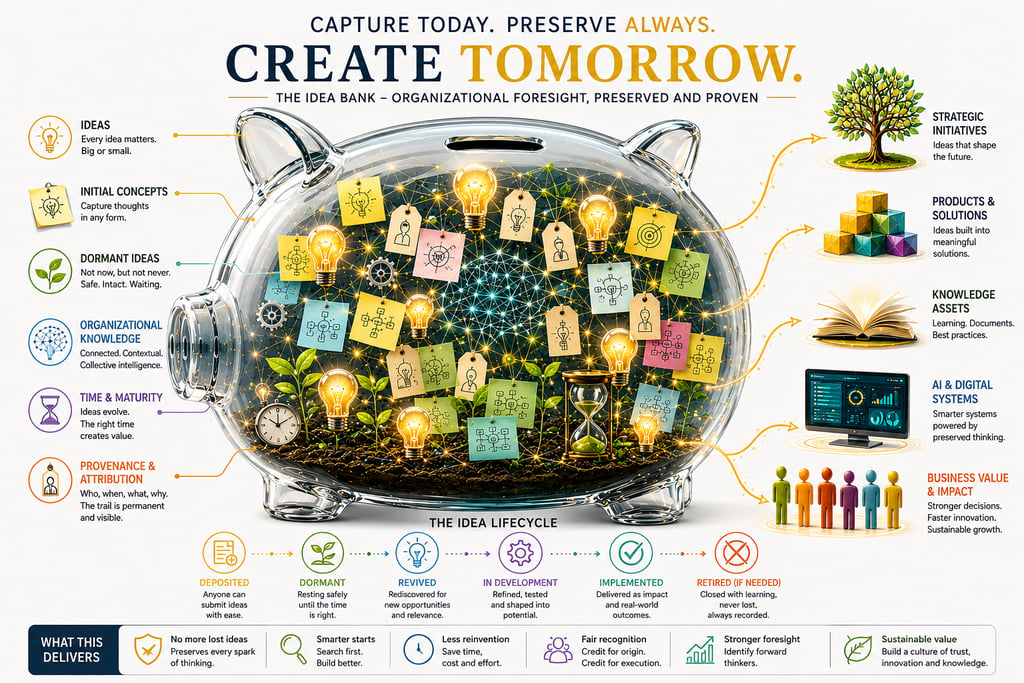
The Idea Bank: The fix is conceptually simple: give early ideas the same institutional home we give validated knowledge. Call it the Idea Bank, a glass piggy bank for organizational foresight, open for deposits from anyone, built on one non-negotiable property: the trail is permanent and visible.
Five design elements make it work
Open, low-friction deposits: Anyone in the organization can submit: a title, a paragraph, a category. Nothing more required. If deposits take effort or approval, only the politically confident will deposit, and the system fails exactly the people whose ideas are most likely to be lost.
An append-only provenance trail: Every idea carries its history, and the history cannot be edited or deleted: who deposited it and when, who has opened it, who picked it up to work on it, every status change. This single property is the difference between an Idea Bank and a suggestion box. Suggestion boxes die because ideas vanish into them. The Idea Bank works because nothing ever vanishes, the glass is the point.
Categorized for the need of the hour: Ideas are tagged by domain, problem type, and maturity, so that when a new initiative launches, a budget appears, or an executive asks "what should we do about X," the first act is to query the bank: has anyone here already thought about this? That query step is the cultural change. Engineers check for existing code before writing new code. Organizations should check for existing thought before commissioning new thinking.
An honest lifecycle: Deposited → dormant → revived → in development → implemented (or retired). The crucial state is dormant. The state most organizations lack a word for. Dormant says "not now" without saying "never." It is the fate premature ideas deserve and almost never receive, because rejection systems only know how to delete.
Revival attribution: When a dormant idea is picked up, the system automatically links the reviver to the originator. Whoever develops the idea gets full credit for the development. Whoever deposited it keeps permanent credit for the origination. Both are visible, always. This is what makes gold rushes fair: the pie can be shared, because the trail shows who planted the orchard.
The graveyard risk — and the two things that prevent it
Let’s test my proposal because experienced practitioners will see the obvious risk. Many organizations have tried similar concepts, an idea portal, an innovation backlog, a parking lot and watched them become graveyards: thousands of submissions, a backlog of reviews no one addresses, contributors who submitted multiple times and eventually gave up. A permanent record of an unread idea is still just an unread idea. Visibility is essential, but not sufficient.
Two things separate a bank from a graveyard, and neither is technology.
The query gate: The bank only lives if consulting it is a mandatory step in how work starts, a standing item in initiative kickoff, business-case templates, and annual planning: "What does the Idea Bank already hold on this?" Engineering made code review a gate, not a favor; the same move applies here. Without the gate, deposits accumulate and retrieval never happens. With it, every new initiative becomes a potential revival event, and depositors see their ideas being searched for which is what keeps deposits coming.
The honored promise: People will share ideas only if the promise of attribution is upheld. The first time a revived idea ships without its originator credited or worse, the first time a deposit is used against its author, the bank dies, whatever the system records. This is why the Idea Bank is ultimately a governance commitment wearing a technology costume: the append-only trail makes broken promises visible, but only leadership behavior makes them rare. An organization unwilling to make that commitment should not build the bank; it will only amplify the existing cynicism
Named honestly: the hard part of the Idea Bank is not the database. It is the query norm and the credit norm. The system is a fortnight of configuration; the culture is the actual build.
What leadership gets
First, let's understand the cost - leaders are buying a behavior change with a small software bill attached, not the other way around.
The organization stops re-buying its own thinking: Every "new" initiative starts with a query against prior thought. Even a handful of revived ideas/year each one skipping months of rediscovery, pays for the system.
Rejection becomes deferral instead of deletion: The organization can say "not now" without destroying the asset. Leaders make better portfolio decisions when "no" is reversible and recorded than when every "no" silently burns the idea.
Foresight becomes visible: Over time, a pattern emerges: whose dormant deposits later got revived and implemented? That is a useful signal, not a scoreboard, and it should never become one — of who in the organization tends to see what the field will need before it needs it. It is a capability no performance review currently captures, held disproportionately by people whose ideas were "wrong" until they weren't. Used generously, it surfaces hidden forward-thinkers; used punitively, it would poison the deposits which is one more reason the credit norm matters more than the code.
Final Thoughts
There is a important observation to make. An organization that cannot trace the origins of its internal ideas- who conceived what, when, and what happened afterward-is demonstrating the same fundamental failure as its poorly managed knowledge bases: information without ownership, history without documentation, and certainty derived from proximity rather than records. The Idea Bank applies knowledge management to the organization’s own ideas. If we recognize that provenance, lifecycle, and retrievability are crucial for customer-facing knowledge, they are equally important for the ideas that determine what gets created.
Many organizations are sitting on a portfolio of dormant foresight they have already invested in and cannot find. The gold rush around AI and knowledge is revealing, in real time, which organizations kept their receipts.
Build the bank. The deposits have already been made - and lying lost, earning nothing for anyone.
Written with AI assistance; image generated with ChatGPT.